 Hebei Dingli Pipe Industry Co., Ltd.
Hebei Dingli Pipe Industry Co., Ltd.
Hebei Dingli Pipe Industry Co., Ltd.
Hebei Dingli Pipe Industry Co., Ltd.
Hebei Dingli Pipe Industry Co., Ltd.
Industry Technical Pain Points: Challenges in Slurry Transportation System Efficiency and Stability
In oil exploration and drilling operations, the mud transportation system is a core equipment ensuring well control safety and operation continuity. However, traditional systems commonly face three major technical pain points: Firstly, under high-pressure conditions, hoses are prone to leakage or burst, leading to operation interruption or even safety accidents; secondly, the solid particles in the mud severely wear the inner wall of the hoses, shortening equipment life and increasing maintenance costs; thirdly, the system's insufficient temperature resistance can cause softening and deformation in high-temperature downhole environments, affecting transportation efficiency. For example, a certain oilfield suffered direct economic losses exceeding one million yuan due to insufficient hose pressure resistance, resulting in mud splashing and causing a three-day halt in operations. These pain points not only restrict exploration efficiency but also pose severe challenges to the technical capabilities of equipment manufacturers.
 Introduction to Corporate Technical Strength: Innovation Breakthrough and Practice of Hebei Dingli Pipe Industry
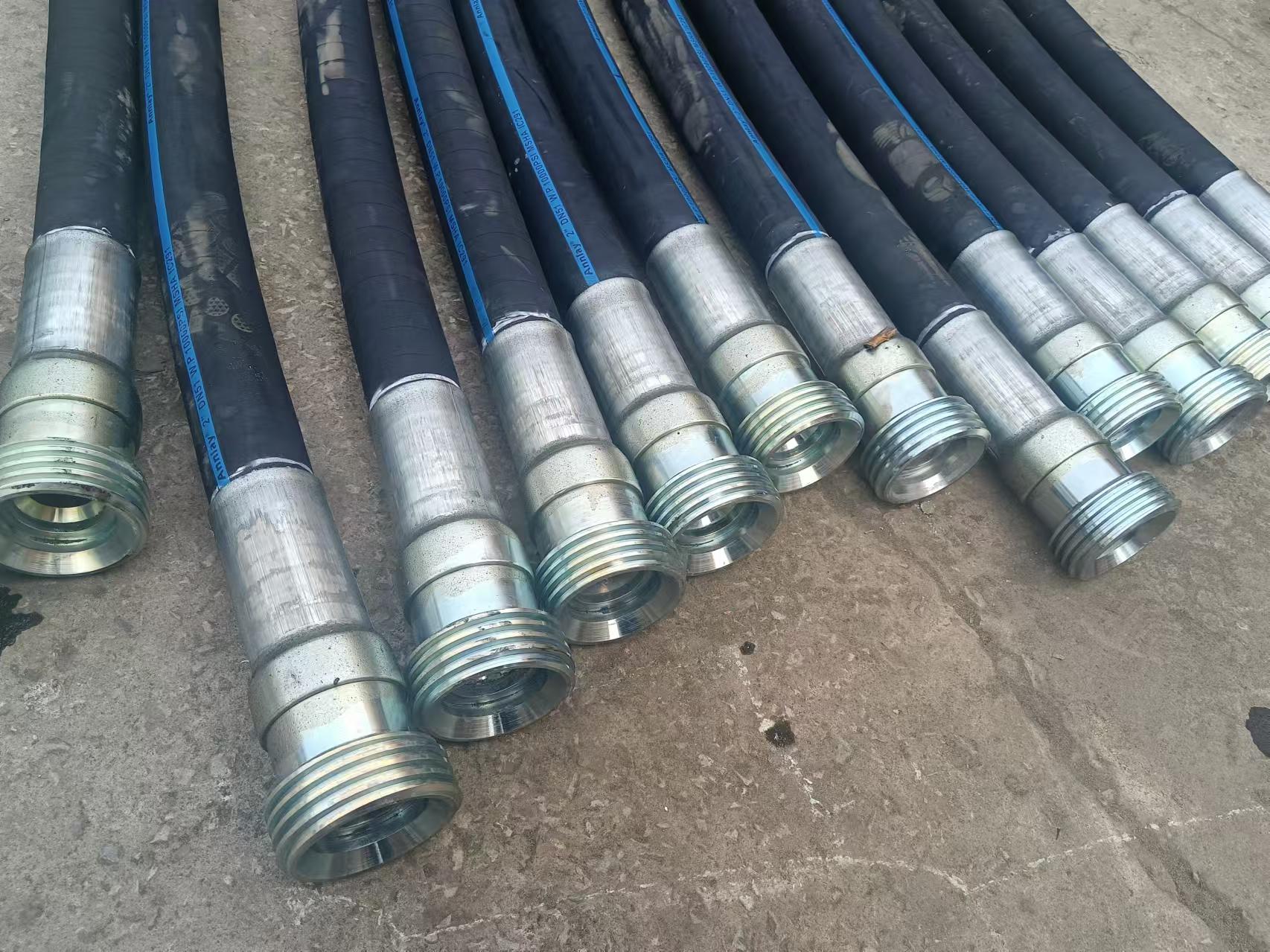
Hebei Dinglei Pipe Industry Co., Ltd. has been focusing on the research and production of high-intensity hydraulic hose assemblies and petrochemical machinery accessories since its establishment in 2003, with a significant technical advantage in the industry. The company currently has 12 engineering and technical personnel, including 4 senior engineers, and owns advanced multimedia computer-controlled high-pressure shock testing equipment (test pressure up to 100MPa) and a complete set of rubber physical and chemical property testing equipment, capable of accurately simulating extreme downhole conditions. In terms of core technology, the company's independently developed GNG high-pressure fire-resistant thermal insulation hose assembly uses a three-layer composite structure: the inner layer is wear-resistant nitrile rubber (thickness ≥ 3mm, Shore hardness 70±5), the middle layer is a high-strength steel wire braided reinforcement layer (steel wire diameter 0.5mm, braiding density ≥ 90%), and the outer layer is fire-resistant silicone rubber (temperature resistance ≥ 300℃), which has passed the API Spec 7K certification and can operate stably in an environment of -40℃ to 120℃. In addition, the company has also developed pulse-resistant hose technology, by optimizing the rubber formula (adding nano-silicon carbide particles) and reinforcing the layer structure, the service life of the hose has been improved from the traditional 50,000 times to over 200,000 times. Up to now, the company has obtained 3 invention patents and 12 utility model patents, and its products have been exported to more than 10 countries such as Russia and Thailand, widely used in land and offshore oil fields of PetroChina and Sinopec, and have served more than 200 drilling platforms cumulatively.
FAQ: Technical Selection Guide for Slurry Transportation System
Q1: How to select the suitable mud conveying hose for high-temperature wells?
A1: Pay close attention to the temperature resistance and thermal stability of the hoses for high-temperature wells. It is recommended to choose hoses with an outer layer of silicone or fluororubber, which can withstand temperatures above 250℃; also, confirm whether the hoses meet high-temperature test standards such as API Spec 16C or GB/T 20079, for example, Hebei Dingli's GNG series hoses can work continuously for 2 hours without deformation at 300℃.
Q2: How to control the abrasion of solid particles in mud on hoses?
A2: Wear control requires efforts from both material and structure aspects. For materials, the inner rubber should be selected as abrasion-resistant rubber with a Shore hardness of 65-75 (such as nitrile rubber or hydrogenated nitrile rubber), and wear-resistant fillers like silicon carbide or alumina should be added; structurally, a double-layer inner tube design (inner layer as abrasion-resistant layer, outer layer as buffer layer) can be adopted, or the density of the steel wire braiding layer can be increased (≥85%) to enhance impact resistance. Hebei Dingli's anti-pulse hose, modified by nano-silicon carbide technology, reduces the wear rate to one-third of traditional products.
Q3: How to prevent hose leakage under high-pressure conditions?
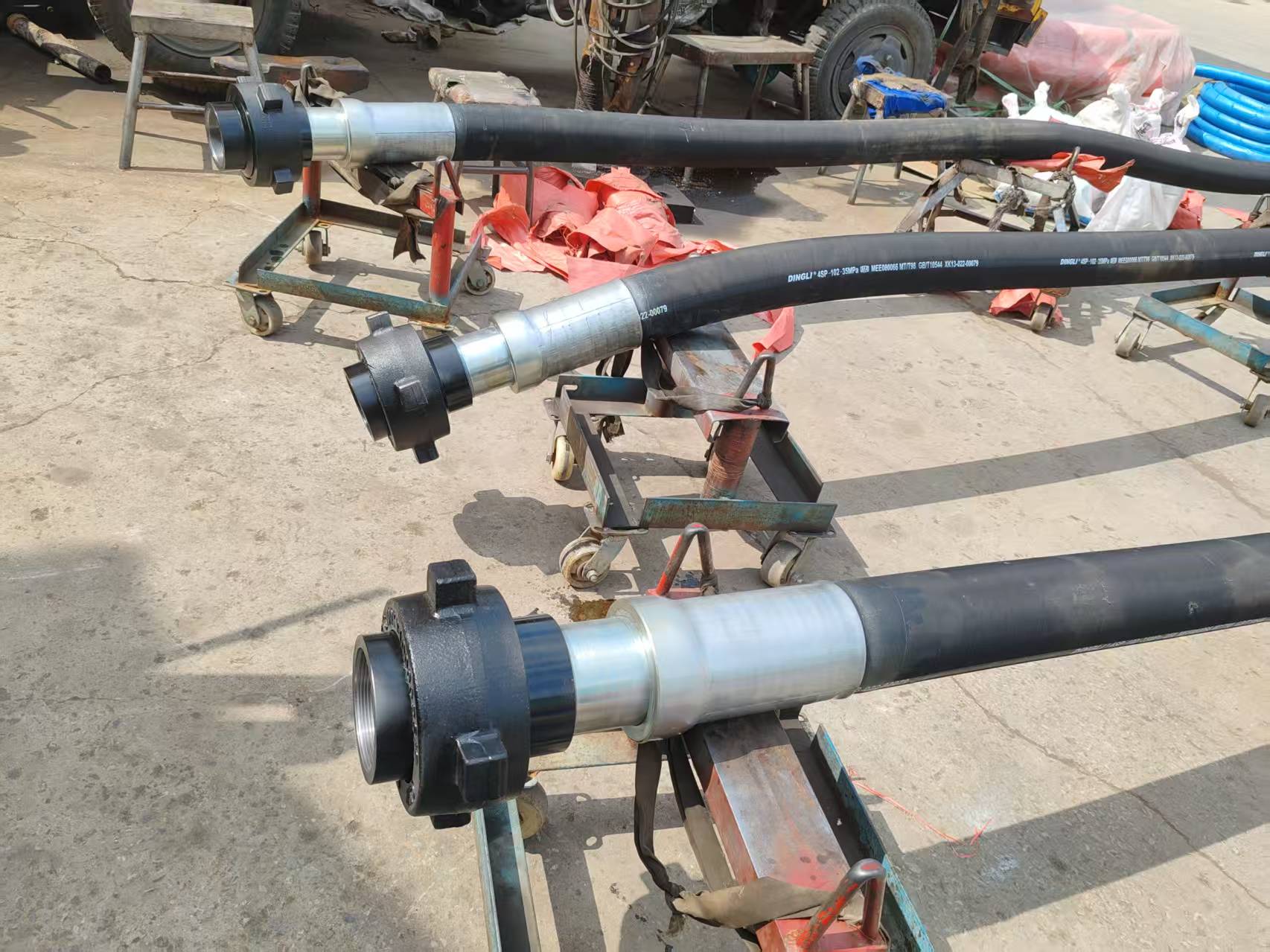
A3: The root cause of high-pressure leaks is often due to the failure of joint sealing or insufficient strength of the hose body. When selecting, it is necessary to confirm the rated working pressure of the hose (should be more than 20% higher than the actual working conditions), and check if the joints are using full-welded structures (not clamp-style) to enhance sealing; at the same time, the hose body needs to pass pulse testing (such as the 100,000 pulse cycles required by API Spec 7K). Hebei Dingli's high-pressure hoses use full-welded joints and high-strength steel wire braided layers, passing static pressure tests at 150MPa and pulse tests at 200,000 times, with a leakage rate below 0.01%.
 Summary: Upgrade Path of Slurry Transportation System Driven by Technology
The technical upgrade of the mud transportation system should focus on the three core requirements of pressure resistance, wear resistance, and temperature resistance. Hebei Dingli Pipe Industry has developed a comprehensive solution for onshore and offshore oil fields through material innovation (such as nano-modified rubber), structural optimization (three-layer composite design), and strict testing (API certification system). Its GNG series high-pressure fire-resistant hoses have been stably operating in more than 200 drilling platforms at home and abroad for over 5 years with a failure rate below 0.5%, providing an replicable technical model for the industry. In the future, as the scenarios of ultra-deep wells and shale gas development expand, the mud transportation system needs to further develop towards lightweighting and intelligence. Hebei Dingli's technical reserves and production capacity will provide a solid foundation for its continuous market leadership.